



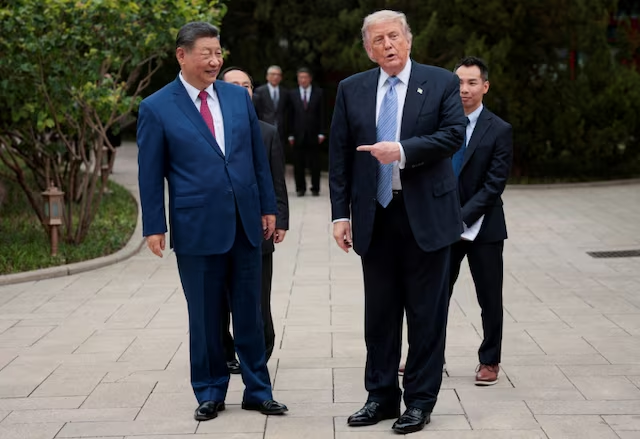
A recent summit between Donald Trump and Xi Jinping has helped reduce short-term geopolitical tensions between the United States and China, though markets remain cautious due to unresolved trade issues and the ongoing Iran conflict.
Pasted text
Trump’s first visit to Beijing since 2017 concluded without major breakthroughs on trade or concrete progress toward ending the US-Israeli conflict involving Iran, which has continued to shake global markets.
Pasted text
Markets React Cautiously
Although investors had limited expectations from the summit, many hoped the talks could help pave the way for a resolution to tensions in the Middle East. Instead, market reaction remained subdued.
China’s currency, the yuan, weakened against the dollar, while Chinese stocks remained mostly flat after recent declines.
Pasted text
Analysts say the summit still delivered one key benefit: reducing uncertainty in US-China relations.
William Bratton, BNP Paribas’ head of Asia-Pacific equity research, said the talks may encourage investors to view Chinese markets as less risky in the long term.
Pasted text
Trade Truce Holds — For Now
Despite the absence of major trade agreements, analysts believe the summit helped preserve the existing trade truce between the world’s two largest economies.
Pasted text
Capital Economics noted that Trump’s invitation for Xi to visit the United States later this year increases the chances that both countries will avoid further escalation in the coming months.
Pasted text
However, uncertainty surrounding tariffs continues to weigh on investor confidence, especially as the current trade truce is expected to expire later this year.
Pasted text
Iran Conflict Remains a Major Concern
One of the biggest disappointments for investors was the lack of meaningful progress regarding the Iran conflict.
China, the largest buyer of Iranian oil, gave no clear indication that it would play a stronger role in ending the crisis.
Pasted text
The discussions also highlighted deep geopolitical differences between Washington and Beijing over the Middle East and the strategic Strait of Hormuz, through which around one-fifth of the world’s oil and liquefied natural gas passes.
Pasted text
Trump claimed Xi agreed that Iran should reopen the critical waterway, though Chinese officials did not publicly confirm that position.
Pasted text
Taiwan and Military Tensions
Taiwan also emerged as a sensitive issue during the summit.
According to analysts, Xi warned Trump that mishandling the Taiwan issue could trigger conflict between the two powers.
Pasted text
Trump added uncertainty by saying he had not yet decided whether to approve a proposed $14 billion arms sale to Taiwan.
Pasted text
“Predictable Rivals”
Economists described the summit as an effort focused more on containing risks than achieving dramatic breakthroughs.
Nomura chief China economist Ting Lu said the two powers appear determined to become “predictable, transactional, and tightly managed rivals” rather than escalating tensions further.
Pasted text
For now, the summit appears to have stabilized relations temporarily — but unresolved disputes over trade, Taiwan, and the Middle East continue to pose major risks for global markets.